The Line as a symbol of imperial violence and impermanence
The Narrow Road to the Deep NorthThe Line as a symbol of imperial violence and impermanence is the railway built through Siam toward Burma under Japanese rule, and the novel’s figure for how imperial ambitions turn people and landscapes into instruments. Planned as a military supply route, it is measured in rails, cuttings, labor quotas, and deadlines; its history is also measured in exhaustion, deaths, missing names, and the remnants that survive after the project itself has failed.
A strategic plan made physical
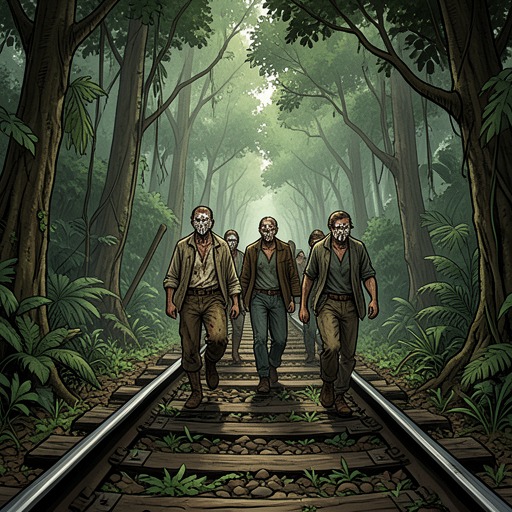
In early 1943, Dorrigo Evans sees surveyors’ pegs marking a route that runs 415 kilometres from north of Bangkok through to Burma. The pegs make a grand and uncertain ambition look suddenly concrete: a line already staked across the land, though the railway exists only as plans, orders, and exhortations. The prisoners receive axes and rope and are assigned to clear a kilometre of giant teak trees along its intended course. The first work is therefore not the laying of track but the conversion of forest into a path for the project.
The railway arises from Japan’s military predicament. The Allies are supplying the Chinese Nationalist Army through Burma, while American control of the seas constrains Japanese transport. Japanese leaders also contemplate taking India through Burma. To move men and matériel overland, Japan needs a railway, but it lacks the money, machinery, and time to build one by ordinary means. The project’s strategic purpose is consequently inseparable from the forced labor used to overcome those limits: imperial urgency is translated into demands on captive people.
The engineering requirements continue to change even as the work proceeds. When Colonel Kota brings new orders to Major Nakamura, the Railway Command Group has altered the design of a major cutting already half completed. It must be enlarged by a third to address gradient problems in the next sector, requiring another 3,000 cubic metres of rock to be cut and carried away. The prisoners lack adequate tools; rock is broken by hand, and the available chisels cannot readily be sharpened when they become blunt. A technical adjustment on paper thus becomes a further burden in a construction system already short of equipment and men.
Labor, command, and human cost
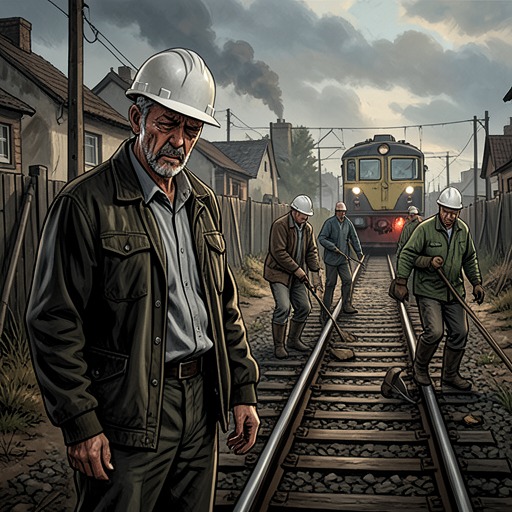
The Line organizes the prisoners’ lives around work. They clear jungle, break rock, shift earth, and carry sleepers and rails with basic implements and their own strength. Food and rest become central concerns, while illness and deaths accumulate in the camp. The surviving men remain Evans’ J Force even as their number diminishes: the force is described as a thousand souls when it leaves Changi, and its identity persists even in the imagined extreme that only one man remains to march out. Their solidarity, strengthened by the deaths of comrades, becomes a counterweight to the system that treats them as replaceable labor.
The project’s logic also shapes the conduct of its commanders. Major Nakamura recognizes the shortage of tools and the declining number of workers, yet understands the railway as an obligation imposed by the Emperor and persists in carrying it out. Colonel Kota states that the work must be completed even if most of the prisoners die, or if everyone dies. In Dorrigo’s view, this reasoning turns prisoners into material for the railway, comparable to its sleepers and rails. The Line is therefore not merely a route through the landscape: it is a system in which the completion of infrastructure is made to outweigh the lives of those compelled to build it.
That system also implicates the people trapped within it in different ways. When Darky Gardiner is punished, Dorrigo understands that Major Nakamura can provide quinine to help sick men work, yet cannot or will not stop the punishment demanded by the railway’s authority. Dorrigo recognizes his own part in the order surrounding the event, and the watching prisoners’ failure to intervene becomes part of the scene’s moral burden. The Line’s violence does not belong only to a distant command structure; its demands reach into the choices and silences of those made to serve it.
Completion, commemoration, and omission
On 25 October 1943, steam locomotive C 5631 travels the completed railway’s length, towing three carriages of Japanese and Thai dignitaries. The milestone of completion stands against the labor and deaths that made it possible: the train passes the remains of people who died building the route, including one in three of the Australians sent to work on it. The railway’s engineering achievement and its human cost occupy the same ground, though the official presentation of the achievement does not give them equal visibility.
C 5631 is later displayed at Yasukuni Shrine in Tokyo, alongside the Book of Souls, which records more than two million people who died in service to the Japanese Emperor between 1867 and 1951. The shrine’s commemoration includes men convicted of war crimes and executed after the Second World War, among them some found guilty of mistreating prisoners on the railway. Yet the locomotive’s plaque does not mention the railway’s construction or those who died building it. Nor is there an agreed total for all the dead. Allied prisoners were only a fraction of the workforce; alongside them labored hundreds of thousands of Asian workers, while estimates of deaths among those workers vary widely. The absence of a settled count is part of the history: many people who bore the cost of the project are absent from its official memorials as well as from any complete record of their names.
Abandonment and impermanence
After the war, the railway loses its military purpose and support. Japanese engineers and guards are imprisoned or repatriated, and the laborers who remain to maintain the Line are freed. The Thais abandon it, the English dismantle it, and local people pull up and sell sections. Then its banks and bridges fail, and its cuttings fill in. The railway that had imposed a seemingly permanent imperial design on the land proves vulnerable to abandonment, weather, and time.
Vegetation returns among the remains of the works and the dead. In later decades, short sections are cleared and made into tourist, sacred, or national sites, but these fragments cannot restore the project’s original purpose or recover the lives and names omitted from its memorial record. The Line’s final significance lies in this double movement: it was built as an instrument of military ambition at immense human cost, yet its physical remains are broken apart and absorbed into a landscape indifferent to the empire that made them. Its disappearance does not undo what happened; it reveals the fragility of the claim that imperial projects can make their power permanent.